Electroplated Stainless Steel UAE: A Fit-Out Buyer's Guide
Electroplated stainless steel is stainless that has had a thin metallic colour layer deposited onto it in a plating bath, so a reception counter, lift surround or cladding panel arrives in gold, black or bronze instead of mill finish. In the UAE the same piece can be quoted as electroplated, PVD coated or plain polished, and the three behave differently on site. Here is how to tell them apart on a drawing before you commit.
What electroplating does to a stainless sheet
The metal comes first. A 304 or 316 sheet is cut, formed, welded and polished, then it goes into the plating line, where current deposits a metallic layer onto the surface. The colour lives in that layer. It is not paint, powder coat or a vinyl wrap, so it does not peel like a film, but it is thin and it sits on whatever polish is underneath.
PVD vs electroplated stainless steel is the question that settles most specifications. PVD deposits a coating in a vacuum chamber, it takes knocks better, and its colour range is narrower and cooler. Electroplating gives warmer golds, rose gold and bronze tones and handles shaped pieces and re-polishing better. Plain brushed or mirror polishing has no colour layer at all, which makes it the honest choice for handrails, kitchen work and drainage, where the piece must survive hard wiping or repair in place.
| Finish | How the colour goes on | Where it earns its place |
|---|---|---|
| Electroplated | Metallic layer deposited in a plating bath over a polished base | Reception fronts, lift surrounds, feature cladding, furniture |
| PVD | Coating deposited in a vacuum chamber | High-touch doors, push plates, trim that takes impact |
| Plain polished or brushed | No colour layer | Handrails, kitchens, drains, service areas |
The colour goes on before the piece leaves the workshop
Plating is the last step in the job, so every hole, cut-out and bracket position has to be settled before it. Once a face is coloured, a drill bit through it leaves a bright ring that no touch-up pen will match. A site weld is worse. That rule changes how the installation is planned: fixings are set at fabrication, brackets hide behind the finished face, and the site team works from the back of the piece, never the front.
This is how the workshop runs it. The electroplated stainless steel interior metalwork is fabricated, polished and plated in Ajman, then packed with protective film and edge protection. It arrives finished. From there it is stored flat, carried with gloves, and installed without silicone smears or a scribe cut through the colour. If a hole turns out to be missing, stop and call. Do not improvise on a visible face.
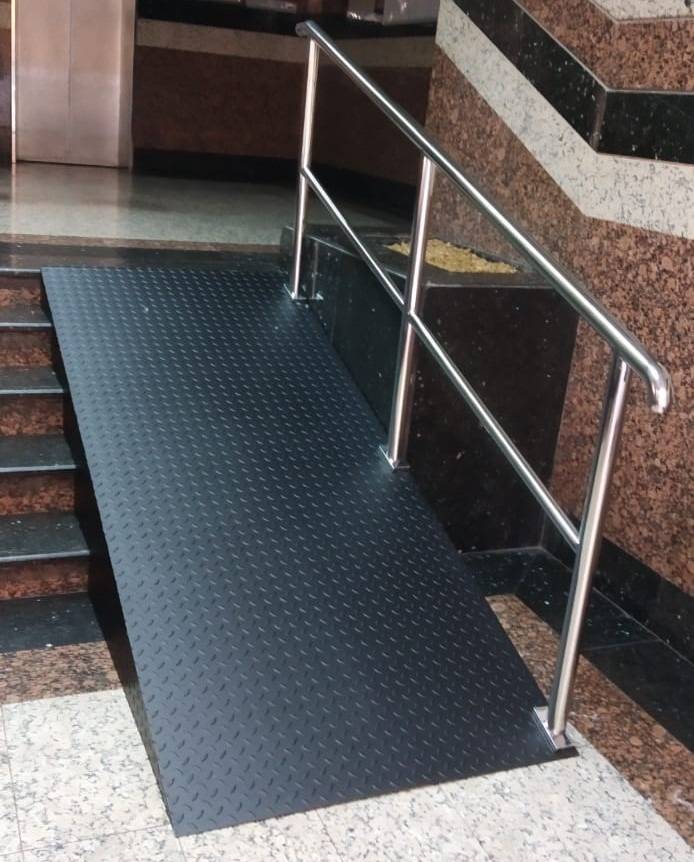 Fixings and cut-outs set at fabrication, so nothing was drilled through a finished face on site.
Gold, black, bronze: the base polish decides the look
The plating bath does not set the final look on its own. The base under it does. Gold over mirror is deep and reflective, the version most people mean by gold stainless steel cladding in Dubai hotel lobbies. Gold over brushed is satin, softer, and far kinder to fingerprints on a door or a lift panel.
Black behaves the same way. A black stainless steel reception counter polished to mirror reads like honed stone and shows every mark. The same black over a brushed base is quieter and easier to live with. Rose gold, bronze and antique tones follow the same rule.
Ask for samples on the base polish you are actually buying, in the thickness you are buying. Thin sheet ripples under a mirror finish and no plating hides that. Look at the samples in the space, under its lighting, not on a showroom bench.
Humidity, grease and hands: what the finish meets in a UAE interior
A coloured layer is thin. Hard abrasion dulls it rather than chipping it, and once dulled it does not come back with polish. That is not a reason to avoid it in a hotel lobby or a restaurant. It is a reason to spec colour where hands and trolleys do not scrape the same square centimetre all day, and to protect the rest.
Coastal projects carry salt air and constant air conditioning, and wet zones carry water. In those places the substrate grade matters more than the colour: specify 316 rather than 304 for anything that stays damp or sits near the coast. F&B grease comes off with pH neutral soap and water, not with a degreaser left to sit.
Cleaning is where most finishes are ruined in the first year. No bleach, no scouring pads or steel wool, no abrasive cream cleanser, no acid based descaler on a coloured face. Warm water, a little pH neutral soap, a microfibre cloth, then dry. Put that on one page and hand it to the client's FM team at practical completion, with the note that the protective film comes off at handover and should not be left baking in sun.
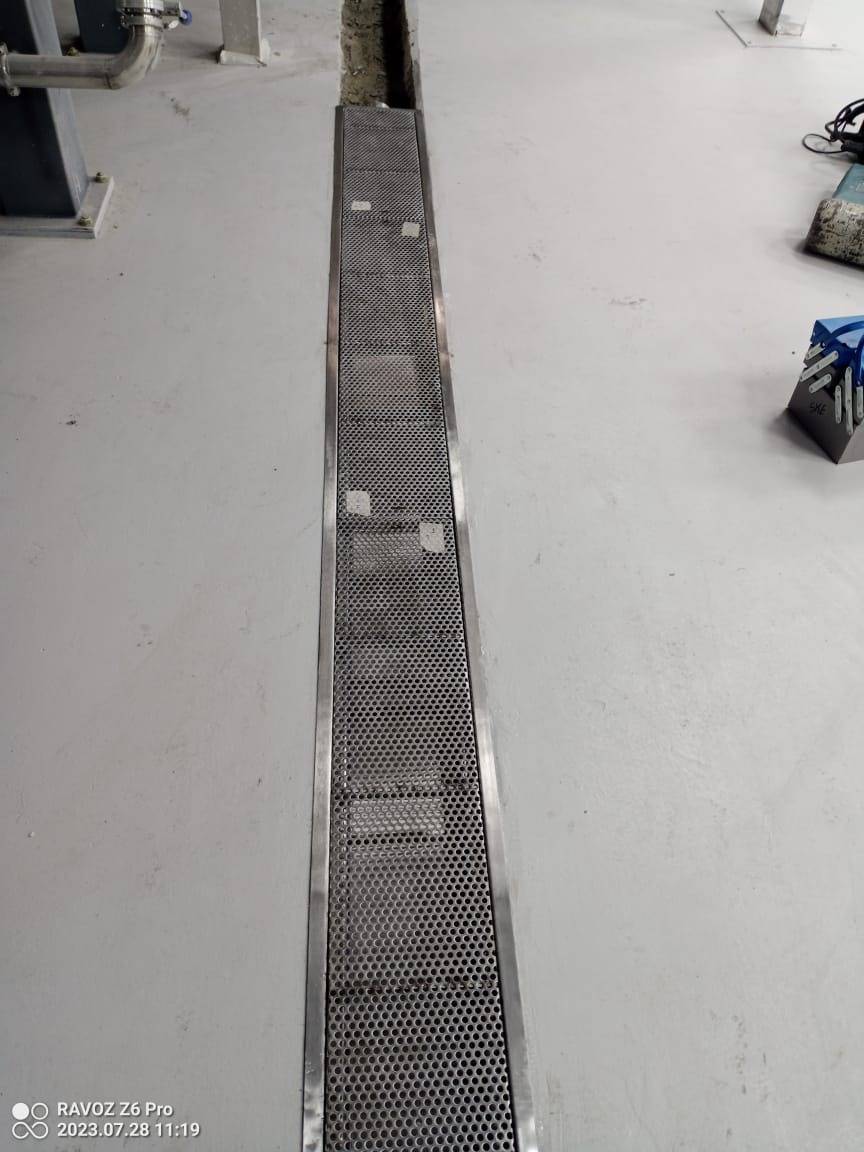 Wet zones and drainage are where grade matters more than colour. Specify 316 here.
What to put on the drawing, and where the date slips
Two quotes for the same gold counter can be far apart without either being dishonest. What separates them is plated layer thickness, how much hand polishing happens before plating, whether the piece is polished again afterwards, and whether all faces are finished or only the one the client sees. A quote that covers the visible face and leaves the returns raw is cheaper. It also looks cheap the first time someone walks behind the counter.
So put it on the drawing: grade (304, or 316 for wet and coastal zones), sheet thickness, base polish, a colour reference, which faces are finished, which edges are visible, and every hardware cut-out, hinge, lock and cable hole. Anything missing becomes a revision, and a revision after plating usually means stripping the piece and starting again. Price comes from that drawing, which is why an accurate quote beats a fast guess.
Lead time runs from the approved shop drawing: cutting and forming, welding, base polishing, plating, hardware assembly, packing, delivery from Ajman. Dates slip for four reasons in my experience. The colour sample was never signed off, the hardware schedule arrived after fabrication, cut-outs were never drawn, or the site had nowhere dry and flat to store the finished piece. None of those are workshop problems, and all of them are avoidable in the week before work starts.
"The price was fair for the steel work. They made the staircase and balcony rails for a full villa. We hired them as a subcontractor on that job. They finished on time and the fit was good." Pushpjeet Singh, 5/5
That is one of 34 Google reviews, rated 5 overall.
To price your job, send the shop drawing or a dimensioned sketch, the colour and base polish you are matching, the grade and thickness if already set, two or three photos of the space, and the site location and emirate. WhatsApp +971 52 270 9796 reaches the workshop fastest: send the drawing on WhatsApp for a free fixed quote and you get a fixed price back, not a range. There are more stainless steel fit-out guides on the blog if the spec is still open.
Frequently asked questions
Is electroplated stainless steel the same as PVD stainless steel?
No. PVD deposits a coating in a vacuum chamber, while electroplating deposits a metallic layer in a plating bath. PVD handles impact and abrasion better and comes in a narrower, cooler colour range. Electroplating gives warmer gold, rose gold and bronze tones and is easier to polish after plating.
Can a scratch in the colour be repaired after installation?
Not to an invisible match. The colour sits in a thin layer over polished steel, so a scratch through it shows as a bright line and a touch-up pen will stand out. Prevention does the work: film until handover, gloves during install, no drilling or cutting on a visible face. A deep scratch usually means the piece returns to the workshop for re-polishing and re-plating.
Which grade should I specify for a coastal or wet area?
316 for anything that stays wet, sits near the coast or is cleaned chemically, and 304 for dry interior faces. Salt air and constant air conditioning are hard on 304 in coastal buildings, and the pitting that follows is a substrate problem, not a finish problem. Put the grade on the drawing so every quote is priced on the same metal.
Can you re-plate a piece that is already installed on site?
Plating happens in the workshop, so a piece already fixed in place cannot be plated where it stands. A fabricated piece can be removed, stripped, polished and re-plated if it can be transported safely. That is why colour and grade are settled before fabrication starts.