Offshore steel works UAE: buyer's guide for EPC teams
Offshore steel works in the UAE covers the fabrication, coating, inspection and load-out of steel structures built for marine, oil and gas duty, from pipe racks and skids to full jacket packages. This buyer's guide sets out the scope, the standards to verify, Gulf coating systems, AED costs and the lead times EPC contractors and procurement teams should plan around.
Why work with APEX STEEL WORKS L.L.C
- Google rating of 5 from 32 customer reviews
- Stainless steel works, GI welding and lathe works handled in house
- Coverage across the United Arab Emirates from one fabrication workshop
- Direct WhatsApp and phone line on +971 52 270 9796
- Detail checking on small parts as well as large frames
What offshore steel works covers
Offshore steel works covers every fabricated steel item that goes offshore or sits on a marine terminal: jackets, topsides modules, pipe racks, skids, helidecks, subsea protection structures and living quarters modules. It uses much the same plate, welders and equipment as onshore structural steel, but the duty and the paperwork are heavier.
Typical packages a UAE fabricator will quote:
- Jacket legs, bracing, piles, launch runners and appurtenances
- Topsides modules, deck extensions, walkways and stair towers
- Pipe racks, pipe supports, cable trays and access platforms
- Process, wellhead and manifold skids
- Helidecks with perimeter netting and landing markings
- Subsea protection structures, mudmats and grillages
- Living quarters modules, blast walls and fire walls
Onshore structural steel for a warehouse in Dubai Industrial City or a shed in KEZAD is priced and inspected to a lighter rulebook. Offshore scope adds corrosion allowance, fatigue and lift analysis, tighter dimensional tolerance, and traceability from mill certificate to load-out. Buyers comparing oil and gas steel fabrication UAE suppliers usually start with the documentation pack, because that is where the weakest bids fail. If an offshore quotation sits close to an onshore rate, one of those obligations has been dropped.
Standards and approvals buyers must verify
Confirm that the quality system is certified, not just described. ISO 3834-2 is the baseline for fusion welding quality, paired with EN 1090-2 at execution class EXC3 or EXC4, or AWS D1.1 where the client specification is US based.
Then verify the project layer:
- WPS and PQR to ASME IX or AWS D1.1, available for review before award
- Class society involvement through DNV or ABS, with agreed witness and hold points
- ADNOC vendor registration for Abu Dhabi offshore and island scope, and Aramco registration where Saudi scope applies
- A client nominated third party inspector and an approved inspection and test plan (ITP)
- Mill certificates to EN 10204 3.1, or 3.2 where the specification calls for it
Licensing and legal scope in the UAE
Ask whether the licence is issued through the Ministry of Industry and Advanced Technology (MoIAT) or through a free zone authority such as Jebel Ali Free Zone, Hamriyah Free Zone or KEZAD. That determines where material can be stored, where inspection can be witnessed and how finished items move to port. The licensed activity must cover metal fabrication and welding, not steel trading. Request the trade licence, establishment card and VAT registration, because a fabricator who cannot produce all three will struggle in a client audit.
 Mid project walkthrough in a commercial interior under renovation, with furniture sheeted and ceiling services still being finished.
Coatings and corrosion protection for Gulf marine conditions
Coating failure is the most common reason an offshore structure goes back to the yard. Salt laden air, months of humidity above 80 percent, hard UV and surface temperatures that pass 70 C on dark steel will defeat a standard paint system long before the 20 to 25 year design life offshore specifications ask for.
What to specify and verify:
- NORSOK M-501 System 1 for atmospheric zones and System 7 for splash zones, with zinc rich primer, epoxy mid coat and polysiloxane topcoat
- ISO 12944 C5-M as the minimum atmospheric category for coastal and offshore UAE, with hot dip galvanising to ISO 1461, commonly 85 microns minimum, on gratings, ladders and handrails
- Abrasive blasting to Sa 2.5, or Sa 3 in the splash zone, with salt contamination tests before the first coat
- Dry film thickness (DFT) records taken per coat, not once at the end
- Stripe coats on welds, cut edges, bolt holes and corners, which is where corrosion starts on offshore steel structures in the UAE
Coating also dictates the programme. Coating shops in Sharjah and Abu Dhabi book out weeks ahead in summer, and blasting stops altogether when humidity passes 85 percent. Schedule weather windows instead of treating coating as a task that happens after fabrication.
Welding quality and NDT
Weld quality on offshore steel is proven by records, not by appearance. Every joint should trace back to a qualified procedure, a qualified welder and a recorded inspection result.
- WPS and PQR for each material and thickness combination, qualified to ASME IX or AWS D1.1
- Welder qualification records with continuity maintained, since qualification lapses after six months without welding in the process
- Visual inspection of 100 percent of welds, with weld maps
- Ultrasonic testing on full penetration structural joints, from 10 percent up to 100 percent depending on criticality class
- Magnetic particle inspection on fillet welds and temporary attachments, and dye penetrant testing on stainless steel and ground areas
- Dimensional control survey covering straightness, squareness, camber and bolt hole alignment
- A documentation pack with mill certificates, WPS and PQR, welder certificates, NDT reports, coating records and as built drawings
They are very professional, knowledgeable, and pay attention to even the smallest details.
Alhaf, 5 out of 5
APEX STEEL WORKS L.L.C holds a Google rating of 5 from 32 reviews, and that level of detail checking is usually the difference between a package that clears final inspection and one that ships with punch list items still open.
What offshore steel works cost in AED
A 20 tonne offshore pipe rack skid, fabricated, coated and NDT tested, runs AED 22,000 to AED 32,500 per tonne all in, or roughly AED 440,000 to AED 650,000 for the package. Hold that range against any quotation you receive, because bids well below it normally exclude coating, NDT or third party inspection.
Where the money sits on a 20 tonne skid:
- Material, plates, sections, pipe and fittings: AED 8,000 to AED 10,800 per tonne
- Fabrication, cutting, fitting and welding: AED 7,000 to AED 9,400 per tonne
- Blasting and coating to NORSOK M-501: AED 3,000 to AED 4,900 per tonne
- NDT, MPI, UT and dimensional survey: AED 1,300 to AED 2,100 per tonne
- Third party inspection and documentation: AED 900 to AED 1,500 per tonne
- Load-out, handling and transport to port: AED 1,800 to AED 3,300 per tonne
Heavier marine structures cost more. A 150 tonne jacket package with legs, bracing, piles and appurtenances typically lands between AED 26,000 and AED 34,000 per tonne, so AED 3.9 million to AED 5.1 million, pushed up by thicker plate, more welding hours, splash zone coating and higher NDT percentages.
Plate and section pricing moves quickly, and structural steel imports into Jebel Ali are the biggest single variable. Our guide to structural steel price per ton in the UAE explains how mill surcharges and import lead times feed into a fabrication rate, which is worth reading before you fix a lump sum.
Excellent service and very good work. The quality was great, and the price was one of the best I found.
Romosh Al Eyoun, 5 out of 5
Send drawings and a bill of materials to request an offshore steel fabrication quote and ask for a line by line breakdown rather than a single lump sum.
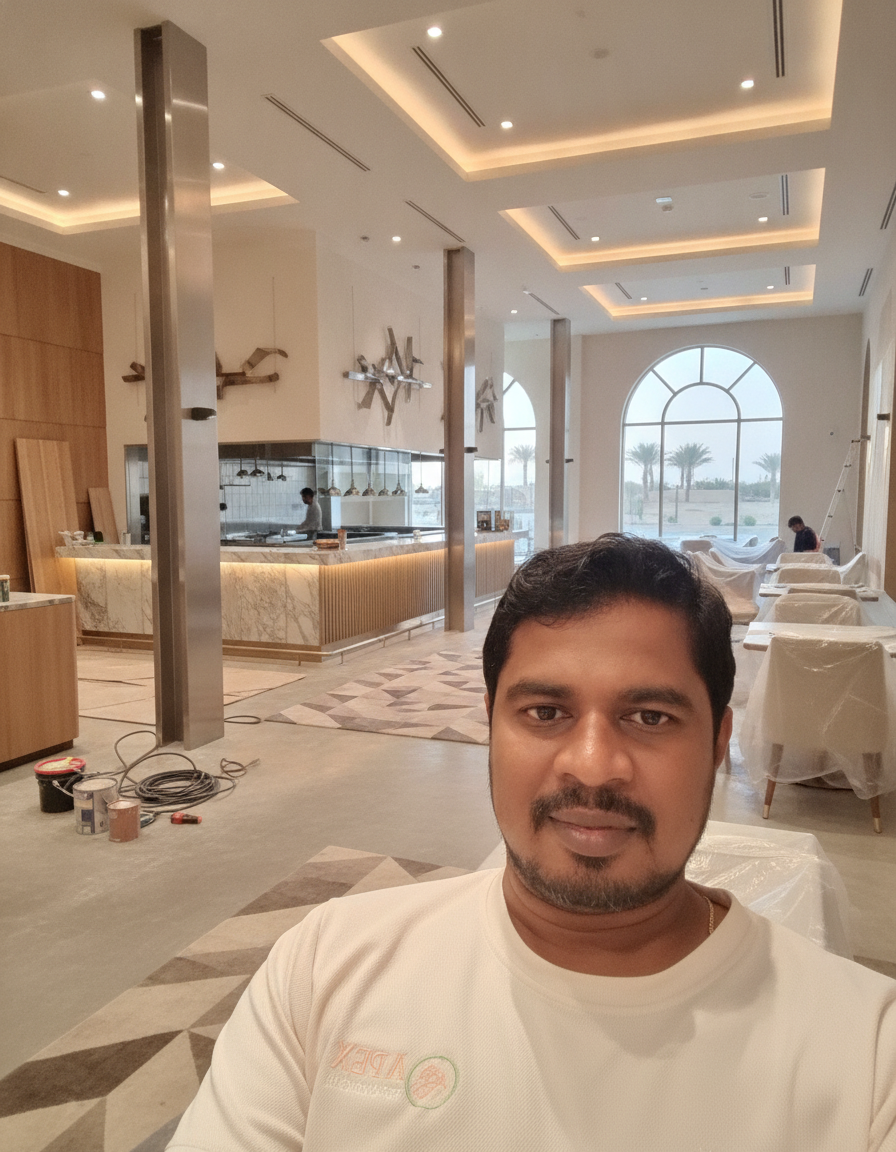 Final stage walkthrough before handover, where dimensional checks and finish tolerances decide sign off.
Lead times, logistics and how to vet a fabricator
A mid size offshore package in the UAE usually runs 10 to 16 weeks from purchase order to load-out. Skids and pipe racks sit at the fast end, while jackets and modules with class society witness points sit at the slow end.
The sequence that governs the programme:
- Enquiry and technical review of drawings, specifications and ITP
- Quotation with material, fabrication, coating, NDT, TPI and transport priced separately
- Purchase order, ITP approval and material release, with mill certificates to EN 10204 3.1 or 3.2
- Cutting, fit up and welding to approved WPS, with progressive NDT
- Dimensional control survey before blasting, then blast, coat and cure with DFT records per coat
- Final inspection, punch list close out, documentation pack handover, load-out and marine transport from a UAE port
Load-out is where inland yards lose weeks. Confirm early whether the workshop can move 150 tonne sections to Jebel Ali, Khalifa Port, Hamriyah or Mina Zayed without road permits you have not budgeted, and whether the yard has hardstand and crane capacity to lift the finished item onto a barge. For a package feeding offshore fabrication Abu Dhabi scope, the load-out point is usually Khalifa Port or Mina Zayed, while Dubai and Sharjah yards typically sail through Jebel Ali or Hamriyah.
To vet a fabricator, ask:
- What is your lost time injury frequency rate over the last 12 months, and can I see the HSE statistics?
- Is NDT done by your own technicians certified to ASNT Level II or ISO 9712, or subcontracted?
- How many tonnes per month can you fabricate, weld and coat at the same time?
- Which offshore projects have you completed in the last three years, and can I speak to the client's QA manager?
- Who is my single point of contact from purchase order to load-out?
Start with the offshore steel works and structural fabrication services page to see the scope covered, then work through the steel fabrication guides, costs and project insights hub for coating, welding and pricing detail.
Frequently asked questions
How much do offshore steel works cost in the UAE?
Expect AED 22,000 to AED 32,500 per tonne all in for a 20 tonne pipe rack skid that is fabricated, coated and NDT tested. Heavier jacket and module work usually runs AED 26,000 to AED 34,000 per tonne. Those figures include material, fabrication, blasting and coating, NDT, third party inspection and transport to port.
Which standards should an offshore fabricator in the UAE hold?
Check for ISO 3834-2 welding quality certification and EN 1090-2 at EXC3 or EXC4, or AWS D1.1 where the specification is US based, with procedures qualified to ASME IX. Offshore units normally involve DNV or ABS with agreed witness points. Commercially, the UAE trade licence must cover metal fabrication, not steel trading.
How long does offshore steel fabrication in the UAE take?
A mid size package usually takes 10 to 16 weeks from purchase order to load-out. Skids and pipe racks land near 10 to 12 weeks, while jacket or module scope with class society hold points runs 14 to 16 weeks or longer. Coating is the most common cause of slippage, because blasting stops when humidity passes 85 percent.
What coating system is used for offshore steel structures in the UAE?
NORSOK M-501 System 1 covers atmospheric zones and System 7 covers splash zones, applied over steel blasted to Sa 2.5 or Sa 3. The atmospheric minimum is usually ISO 12944 C5-M, with hot dip galvanising to ISO 1461 on gratings, ladders and handrails. Gulf conditions call for a 20 to 25 year design life.
Can a UAE fabricator supply ADNOC and Aramco registered scope?
Yes, provided the fabricator holds the vendor registration and can support the inspection regime that comes with it. ADNOC registration covers most Abu Dhabi offshore and island scope, while Aramco registration applies to Saudi work. Confirm registration status in writing at tender stage, along with the approved ITP and any client nominated inspector.