Steel structure vs concrete cost UAE: 2026 build guide
For industrial and warehouse shells in the UAE, a pre-engineered steel frame usually costs 20 to 35 percent less than a reinforced concrete frame and finishes three to five months sooner. Concrete still wins for heavy floor loading and wet process plants. Here is where the crossover sits in 2026.
Why work with APEX STEEL WORKS L.L.C
- Google rating 5.0 from 32 customer reviews
- In-house steel fabrication, stainless steel (SS) and GI welding
- Lathe and machining works handled in the same workshop
- Warehouse, industrial and commercial steel projects across the United Arab Emirates
- Fixed-price quotation issued before fabrication begins
- Direct line to the workshop on +971 52 270 9796
What actually drives the comparison for industrial buildings
Weight is the first driver. A single-storey warehouse PEB frame weighs about 55 to 75 kg per m2 of floor area. The same building in RC adds 400 to 600 kg per m2 of concrete and blockwork. That gap runs straight into pad footing sizes, piling needs and the volume of excavation and backfill a contractor has to move.
Three cost buckets decide the outcome:
- Superstructure: steel is fabricated off site and bolted, concrete needs formwork, rebar, pours and curing cycles.
- Substructure: a lighter steel frame cuts foundation concrete by 30 to 50 percent.
- Envelope: steel uses insulated sandwich panels, concrete uses blockwork and render, slower on site but cheaper per m2 in parts of Sharjah and Abu Dhabi.
Span is the second lever. Clear spans of 30 to 40 m with no internal columns are routine in steel, so racking runs the full width. RC gets expensive past 12 to 15 m because you start paying for columns that break up the racking layout.
Cost per m2 and per ton in the UAE in 2026
Budget AED 620 to 900 per m2 for a steel PEB industrial shell and AED 850 to 1,250 per m2 for RC. Fabricated and erected structural steel is running at AED 4,500 to 6,500 per ton, with raw hot-rolled sections at AED 2,700 to 3,300 per ton.
| Cost element | Steel PEB frame | RC concrete frame |
|---|---|---|
| Foundations and ground slab | AED 90 to 150 per m2 | AED 180 to 280 per m2 |
| Superstructure supply and erect | AED 320 to 480 per m2 | AED 550 to 800 per m2 |
| Roof and wall envelope | AED 130 to 210 per m2 | AED 110 to 220 per m2 |
| MEP, fire protection, doors | AED 110 to 160 per m2 | AED 110 to 170 per m2 |
| Shell total | AED 620 to 900 per m2 | AED 850 to 1,250 per m2 |
| Site programme | 8 to 12 weeks | 20 to 30 weeks |
Worked example: a 2,000 m2 warehouse in Dubai
Steel option: foundations and slab AED 240,000, 130 tons of fabricated steel at AED 5,800 per ton AED 754,000, cladding AED 340,000, MEP and fire protection AED 260,000. Total about AED 1.6 million, or AED 800 per m2.
Concrete option on the same plot: foundations and slab AED 460,000, frame and roof beams AED 1.24 million, blockwork and roofing AED 440,000, MEP AED 280,000. Total about AED 2.42 million, or AED 1,210 per m2.
That is a gap of roughly AED 820,000 on one shed. The material input behind those numbers is set out in our guide to the structural steel price per ton in UAE.
The quality was great, and the price was one of the best I found. Romosh Al Eyoun, 5 stars, Google review
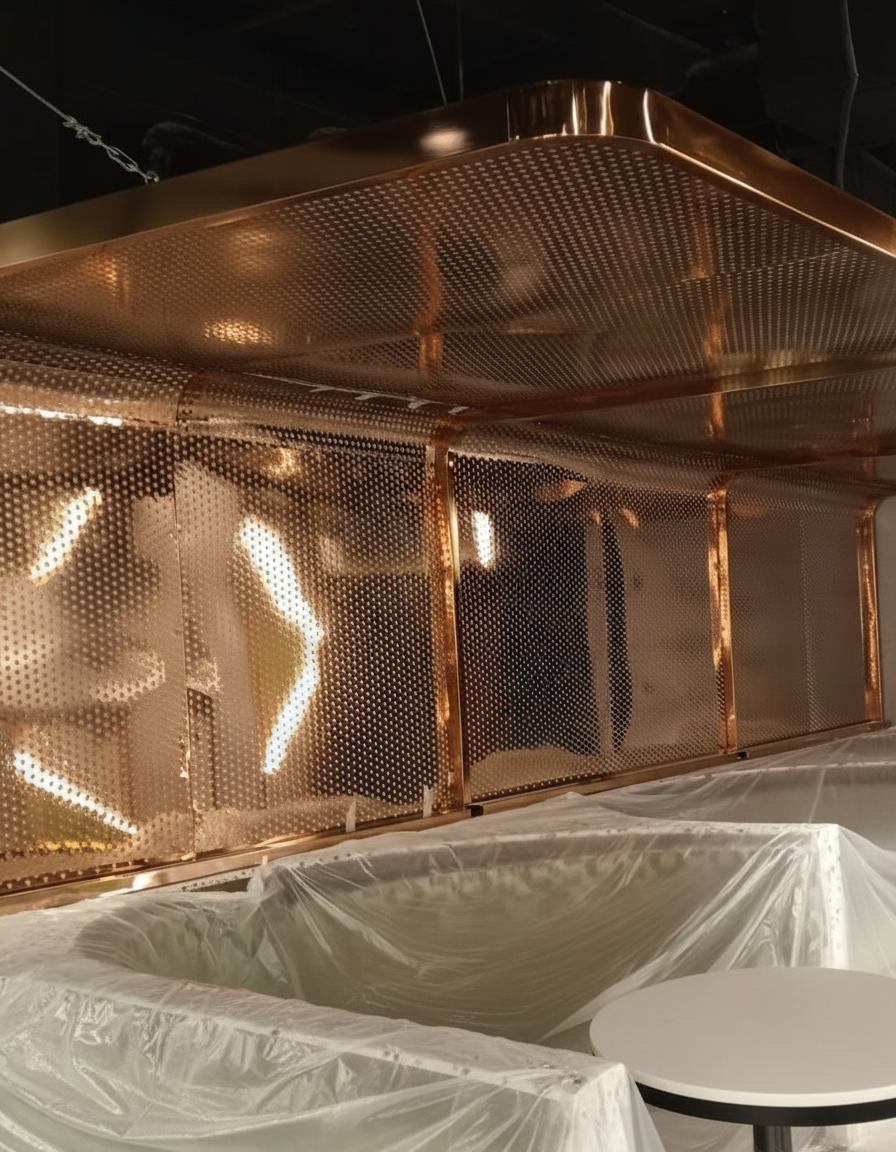
Steel ceiling features fabricated and installed above booth seating during an ongoing commercial fitout in the UAE.
Programme and site time
Steel erects in 8 to 12 weeks on a 2,000 m2 shed. The same footprint in RC runs 20 to 30 weeks, because every column and beam needs formwork, rebar fixing, a pour and a curing wait before the next lift. Steel also shaves 4 to 6 weeks off the foundation stage through lighter pad footings.
Early handover is money. A 2,000 m2 warehouse let at AED 400 per m2 per year earns about AED 66,000 a month. Finishing 12 weeks earlier pulls roughly AED 200,000 of rent into the same financial year, before you count the site supervision, crane hire and overheads a shorter programme avoids.
For the full steel-side build-up, see warehouse steel structure Dubai: cost, approvals and build times.
Span, clear height and future expansion
PEB frames deliver 30 to 40 m clear spans and 8 to 12 m clear heights as standard, which suits high racking and mezzanine layouts. A frame detailed with 20 to 30 percent reserve capacity in the columns lets you bolt in a mezzanine two or three years later without strengthening anything. Adding a bay to a steel shed is a bolted connection and new cladding. Adding one to an RC shed means drilling into existing columns, rebar couplers and often a structural strengthening review. Ask for the reserve capacity in writing at tender stage, because it costs very little at design stage and a great deal afterwards.
UAE approvals, certification and compliance
Steel and concrete follow different approval paths, and the steel path is documentation heavy. In Dubai, industrial projects go through Dubai Municipality and Civil Defence, with free zone plots handled by the relevant authority such as Trakhees. In Abu Dhabi, submissions go to the Department of Municipalities and Transport (DMT) and Abu Dhabi Civil Defence. Expect this sequence:
- Structural drawings and a fire strategy submitted for approval.
- Mill certificates to EN 10204 3.1 issued for every heat of sections and plates.
- Hot-dip galvanising to ISO 1461, minimum 85 microns average on sections over 6 mm.
- Welding procedures, welder qualifications and NDT reports issued for structural welds.
- Intumescent coating or fire boards applied to match the approved Civil Defence drawing.
- Final inspection and completion certificate before handover.
Stainless steel and GI work on doors, canopies and fitout elements is usually inspected against the same approved specification.
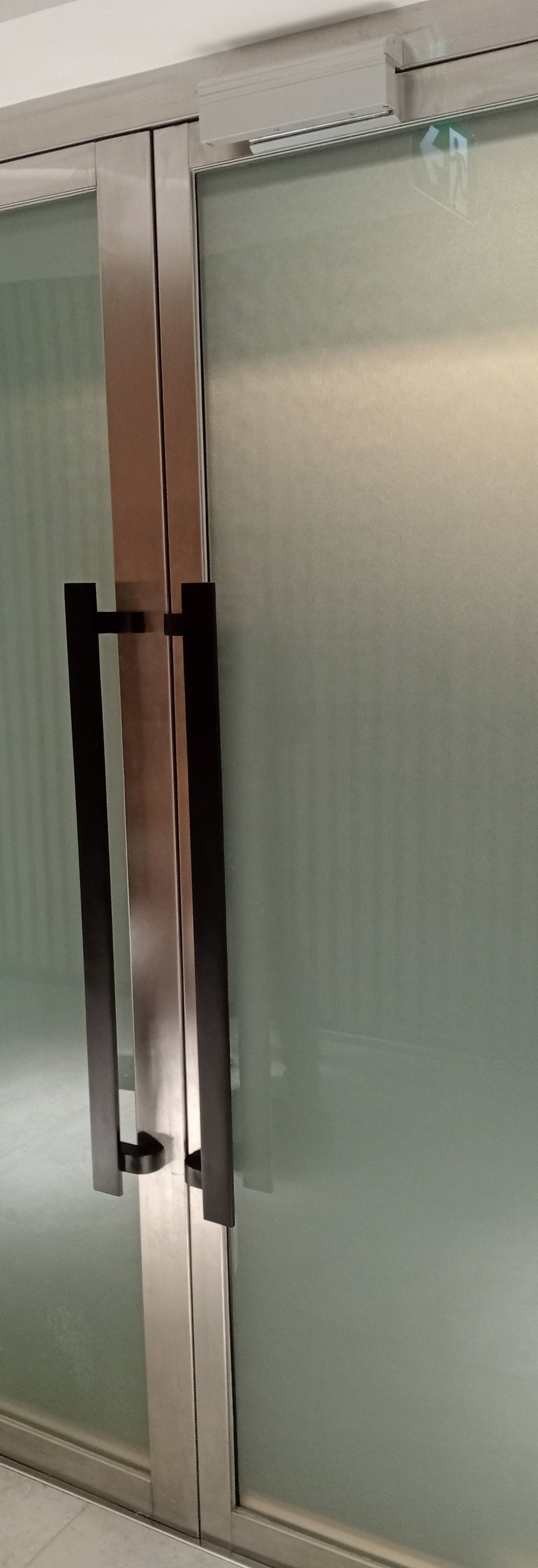
Brushed stainless steel door frames and automatic closers, finished to the approved fire and access detail.
Lifecycle, maintenance and when concrete genuinely wins
A galvanised steel frame inside a dry warehouse needs almost no maintenance for 20 years or more, and steel keeps a scrap value of roughly AED 900 to 1,300 per ton in the UAE today. Frames can also be unbolted and re-erected on another plot. Concrete gives a long service life, but demolition carries a cost and inert waste disposal runs AED 30 to 60 per ton with no salvage.
Concrete still wins in these cases:
- Floor loading above 1,000 kg per m2, or heavy plant, tanks and vibrating machinery in an F&B processing line.
- Wet process areas with washdown, drainage falls and chemical exposure.
- Multi-storey blocks with suspended slabs above the ground floor.
- Blast or impact resistance requirements.
- Tight plots where a crane simply cannot be mobilised.
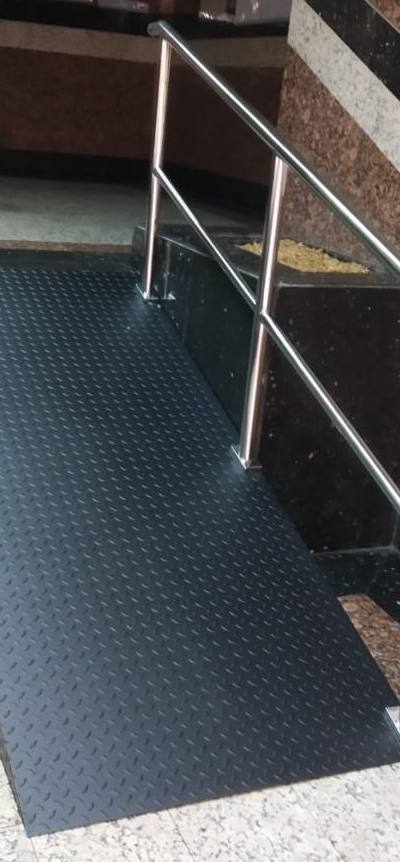
Whichever frame you choose, cladding, doors, louvres, handrails and stainless fitout items come from the same fabrication scope. See our steel fabrication and erection services in the UAE for the full list, or request a steel structure quotation with your drawing and tonnage estimate.
Frequently asked questions
Is a steel structure cheaper than concrete for a warehouse in Dubai?
For a single-storey warehouse shell, yes. Expect 20 to 35 percent lower superstructure and foundation cost, which on a 2,000 m2 shed in Dubai is roughly AED 800,000. Multi-storey blocks with heavy suspended floors are the exception where RC can price out better.
How much is structural steel per ton in the UAE in 2026?
Raw hot-rolled sections run AED 2,700 to 3,300 per ton. Fabricated, galvanised and erected PEB steel sits at AED 4,500 to 6,500 per ton, depending on span, coating specification and total tonnage.
How long does it take to build a steel warehouse in Dubai?
Steel erection on a 2,000 m2 shed takes 8 to 12 weeks once foundations are ready. Add foundations, approvals and Civil Defence sign off and the whole project lands at 16 to 20 weeks, against 28 to 36 weeks for a comparable RC shed.
Do I need Civil Defence approval for a steel warehouse in the UAE?
Yes. Steel needs an approved fire protection design, usually intumescent coating or fire boards on columns and rafters. In Dubai the submission goes through Dubai Municipality and Civil Defence, and in Abu Dhabi through DMT and Abu Dhabi Civil Defence.
Can a steel frame take a mezzanine or be expanded later?
Yes, if the frame was designed for it. Ask for 20 to 30 percent reserve capacity in the columns and rafters at design stage and the mezzanine can be bolted in later with no strengthening. Adding that capacity to an existing frame afterwards is far more disruptive and expensive.