Electroplated vs PVD stainless steel finish: a spec guide
Electroplating builds a metal layer onto a formed part in a tank. PVD lays a very thin coating in a vacuum chamber. Both are settled at the fabrication stage, on the drawing, well before a panel reaches site.
What each process actually is, in workshop terms
Electroplating is a tank process. The part goes in already formed, welded and polished. It is cleaned, immersed, and a metal layer builds across the surface. Because the whole part is submerged, the layer follows the geometry: welded corners, returns, tight radii, re-polished seams. Thickness is measurable, and the layer can be stripped and done again.
PVD is a vacuum process. Parts load into a chamber, a metal target is vaporised, and the vapour condenses as a thin film. The coating is hard and holds colour well. It is also thin and directional: what the vapour can see, it coats.
Neither is a site operation. The choice is made when the piece is drawn and welded, not when it lands in the lobby.
Where each one wins
Electroplating suits complex geometry. A bar counter front with a welded frame, a folded shroud, a front that meets a return at a re-polished seam: the finish has to arrive after the last weld and the last grind, because plating covers the heat-affected zone. Welded frames, sculpted reception counters and curved sections usually go this way.
PVD suits large flat panels and surfaces that get handled. Lift lobby cladding, wide wall panels, door pulls, table tops. The coating takes abrasion from hands and cloths well, and identical flat panels coat identically, batch after batch, which matters when one panel repeats forty times down a corridor.
Both share one trait. On mirror polish and on black, every fingerprint shows. That is the surface, not a fault.
 electroplated vs PVD stainless steel finish gets decided." loading="lazy" decoding="async" />
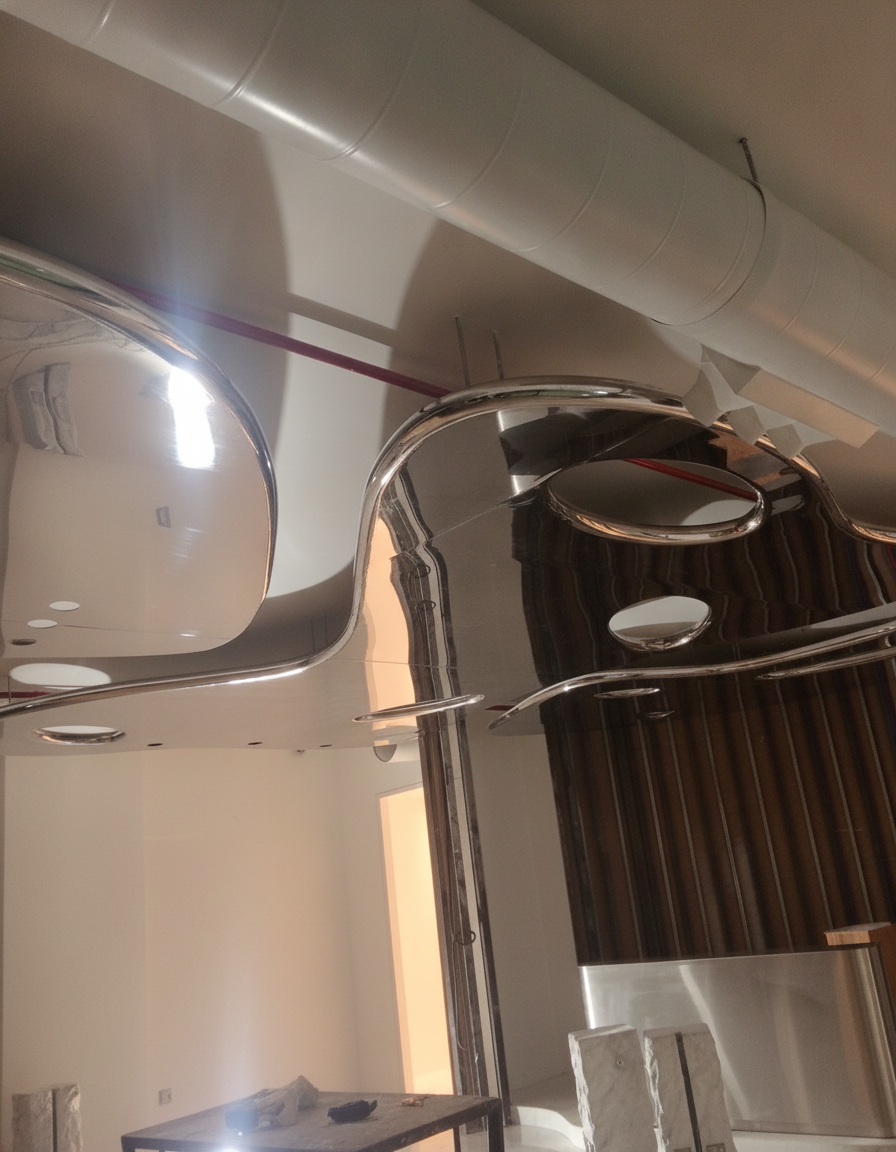
Polished chrome ceiling elements over exposed services during a commercial fit-out, before the surrounding finishes close up.
The three questions that decide it
- Will anything be welded or ground after the finish? If yes, electroplate, or redesign the joint as a mechanical one.
- Can the piece come off later for refinishing, or is it fixed? A plated panel behind a sealed reception desk cannot be re-plated without demolition.
- What will housekeeping actually use? Ask for the product name. Chloride and acid cleaners attack thin decorative layers at the edges first.
Answer those three and the process usually picks itself. Colour, gloss level, brushed or mirror, is a separate question answered with a physical sample.
Failure modes that kill a finish
Weld burn. A frame welded after plating loses the finish at the joint, and the repair never matches. This is the most common and the most expensive.
Edge coverage on sharp folds. A tight fold with a burr pulls the coating thin, and that thin edge is where lifting starts.
The wrong cleaner. Acid and chloride products spot a decorative layer and eventually pit it. Write a neutral pH cleaner into the handover.
Handling on site. A plated panel leaned against a wall for a fortnight picks up scratches, and then it is the finisher's word against the site's. Ask for corner protection and a signed delivery check on stainless steel reception counter cladding and bar front panels.
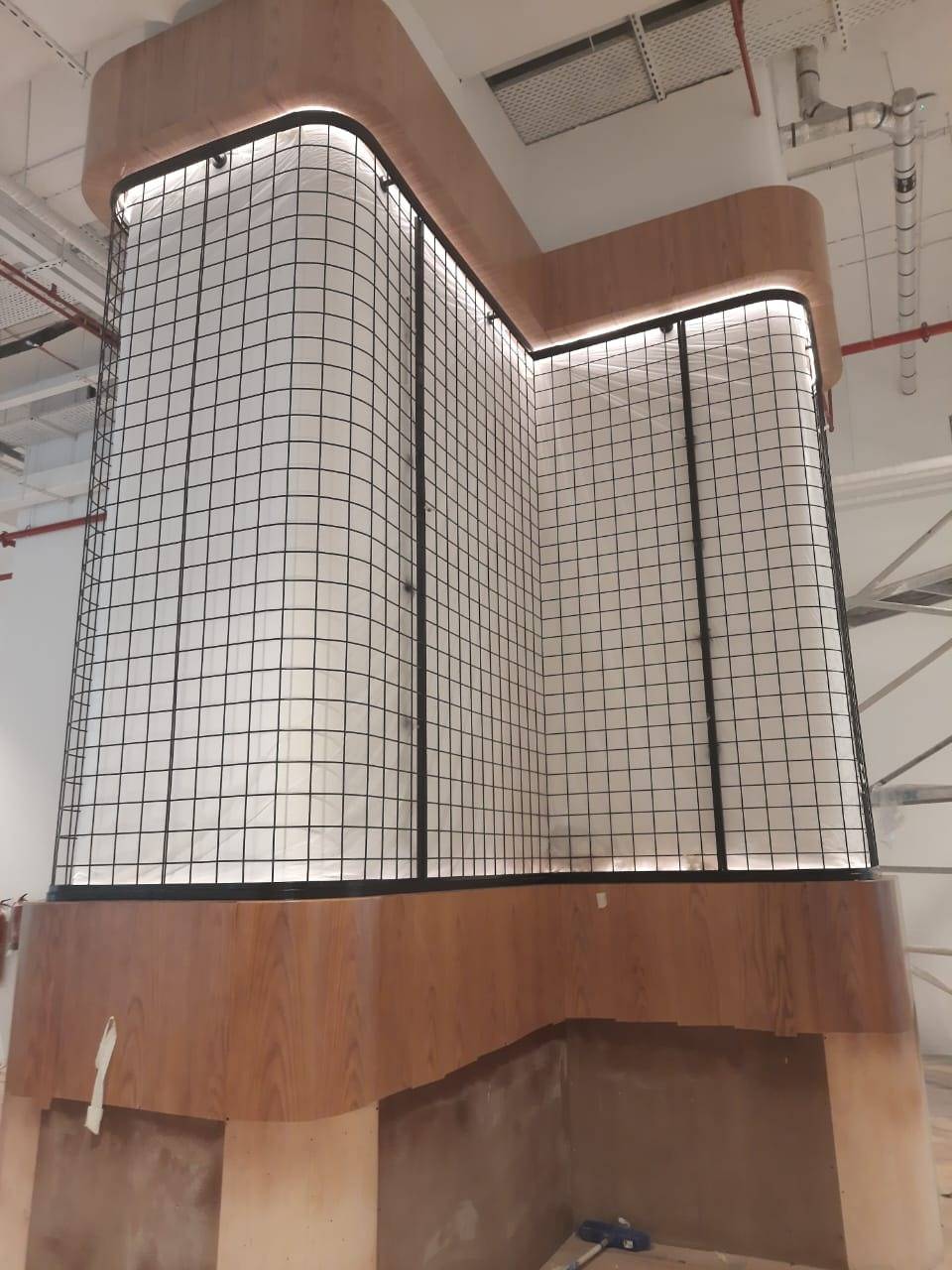
A curved partition with wood paneling, a black metal grid screen and LED strip lighting, installed during a commercial renovation.
Holding a batch together, and what to send for a quote
Colour drift between batches is the quiet problem on hotels and chain restaurants. Control it three ways: sign off a physical sample, plate or coat the whole project from one batch where quantity allows, and order spares.
The spare that matters is the one nobody remembers. A spare clamp, a spare skirting length, an offcut in the same finish. When a trolley hits the bar front in six months, a spare in the store room is a swap. Without it you are matching a new piece against a finish that has aged under lights. If the reference is still open, more stainless steel fit-out guides cover sample sign-off and batch control.
This is where an in-house line changes the conversation. Finish and fabrication sit in one scope, so there is no plater blaming the fabricator for a weld and no fabricator blaming the plater for the colour. We make stainless steel interior metalwork for fit-out in our own workshop in Ajman, and the plating happens in the same building. The Google rating stands at 5 from 34 reviews.
The price was fair for the steel work. They made the staircase and balcony rails for a full villa. We hired them as a subcontractor on that job. They finished on time and the fit was good. Pushpjeet Singh, 5 stars
For a fixed quote, send five things: the drawing, the alloy and thickness, a finish reference (a sample if you have one, otherwise a photo plus the name of the finish you are matching), the quantity, and the install date. That is enough to price it fixed off the drawing, rather than as a rate per metre that moves once the welds are counted.
Send the drawing on WhatsApp for a fixed quote, add the site location, and add a photo if the piece has to sit against a wall that is already tiled. Access changes the answer. A tower lobby in Dubai with a loading bay booking and a service lift is not the same delivery as a low-rise restaurant in Sharjah where the counter walks in through the front door. Abu Dhabi is the long run from the workshop, so the delivery slot matters as much as the drawing.
Frequently asked questions
Does electroplating peel off stainless steel?
A properly prepared plating on stainless does not peel in normal interior use. Failures usually trace back to contamination before plating, a sharp burr at a fold, or the wrong cleaning chemical. If a layer lifts at an edge, treat it as a preparation issue rather than a fault in the process itself.
Can a scratched plated piece be re-plated?
Yes, if it can come off the wall. The old layer is stripped, the surface is polished again and the part goes back in the tank. That is a workshop job, not a site repair. A PVD coated piece can be re-coated on the same condition: it has to be a part you can remove.
Which finish should I use for a bar counter front?
Electroplating, in most cases. Bar fronts get welded frames, folded sections and re-polished seams, and plating after fabrication covers those joints. If it is a flat removable panel with no post-finish welding, PVD is a fair choice and handles daily contact well.
Can PVD be applied to a welded frame?
Only if all welding and grinding is finished first. The frame cannot be welded after coating, because the heat destroys the film and the repair shows. Design the frame with mechanical fixings if the finish has to be PVD.
Will two batches of gold stainless match?
Not guaranteed. Same reference and same process, but plating thickness and substrate polish both shift the colour slightly. Sign off a sample, keep the batch together, and hold spares if the project has repeat units.